
Mathematical modeller and software developer.
Auckland Bioengineering Institute, University of Auckland
A multiple-oscillator mechanism underlies antigen-induced Ca2+ oscillations in Jurkat T-cells
Summary:
This is the first out of three papers that came out of a collaboration between my supervisor James Sneyd and the Trebak Lab at the University of Pittsburgh. The team at the Trebak Lab were calcium signalling in T-cells; in other words, they were studying the transport of Ca2+ in and out of these cells. It was pretty well known at the time of publication that Ca2+ signals in these cells were driven by a Ca2+ release-activated Ca2+ (CRAC) channel, which sits on the membrane of the cell. So a natural question for them to ask was: what happens when that channel stops working?
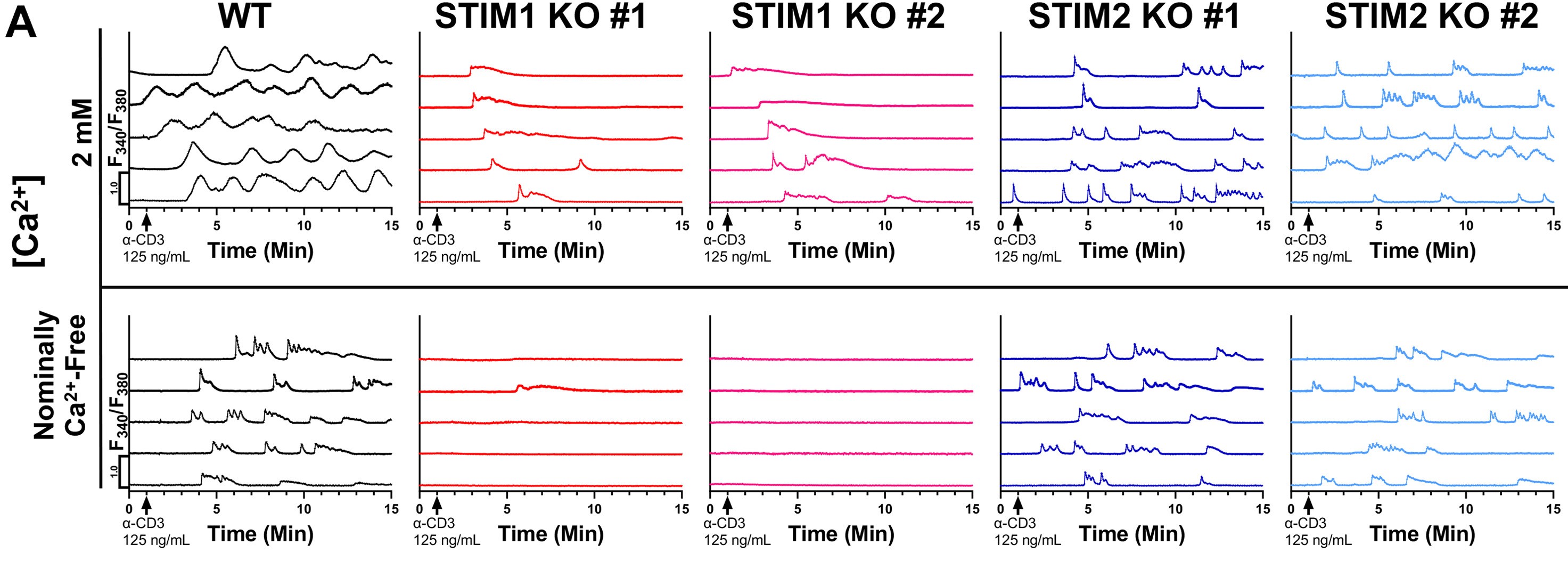
To do that, they disabled the two molecular ‘switches’ that make up the CRAC channel: the STIM1 and STIM2 proteins. In the image above, you can see the type of oscillations seen in a ‘healthy’ cell in black (WT), and those observed in a cell without STIM1 in red (STIM1 KO) and without STIM2 in blue (STIM2 KO). What the team were expecting to see was oscillations disappearing in cells without STIM1 and/or STIM2, What they found instead is that a second type of oscillations rises in these scenarios.
My supervisor and I were then approached to create a model which could reproduce these results (and hopefully shine some light on why this was happening). A preliminary version of our mathematical model is included in the later section of this paper, but the full model would still need to be worked on before presenting a more concrete hypothesis for this behaviour.