Mathematical modeller and software developer.
Auckland Bioengineering Institute, University of Auckland
A Model for the Coexistence of Competing Mechanisms for Oscillations in T-lymphocytes
Summary:
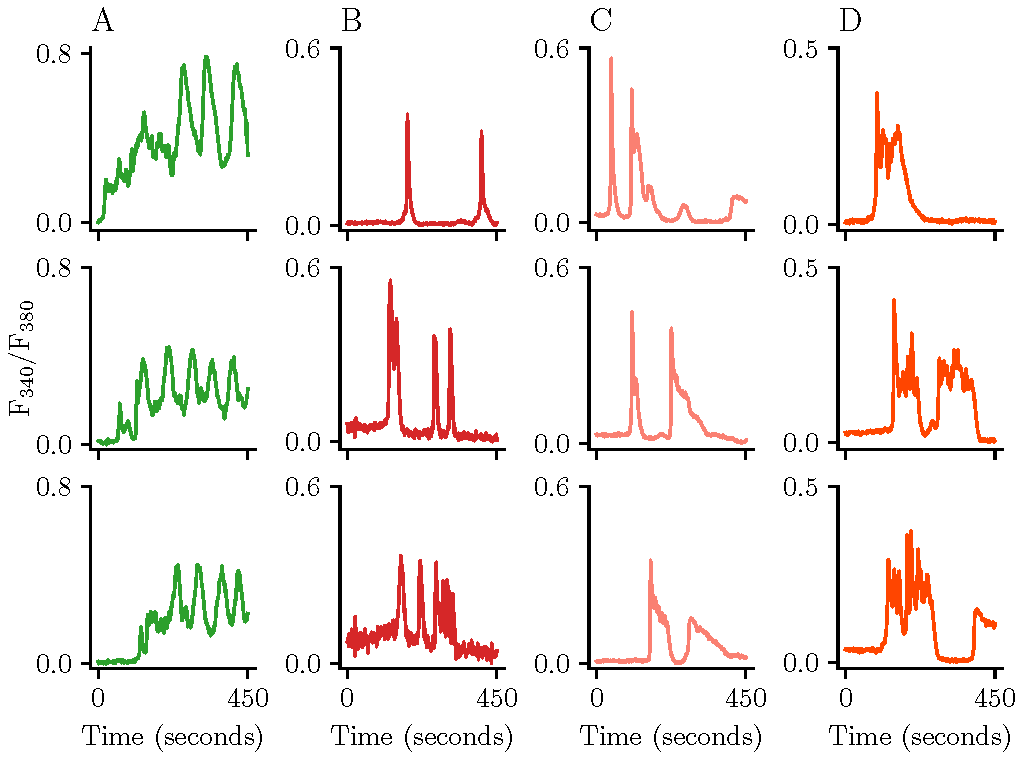
Following up from our first paper with the Trebak Lab, my supervisors and I went back to the drawing board to try to create a robust model that could replicate the different types of oscillations we observed on the experimental data. First, we focused solely on the unaltered (WT) cells, and realised that cells with access to an external source of Ca2+ (green) always oscillated with a broad ‘wave-like’ pattern; on the other hand, oscillations in cells deprived of external Ca2+ (red, salmon, and orange) consisted of spikes and peaks
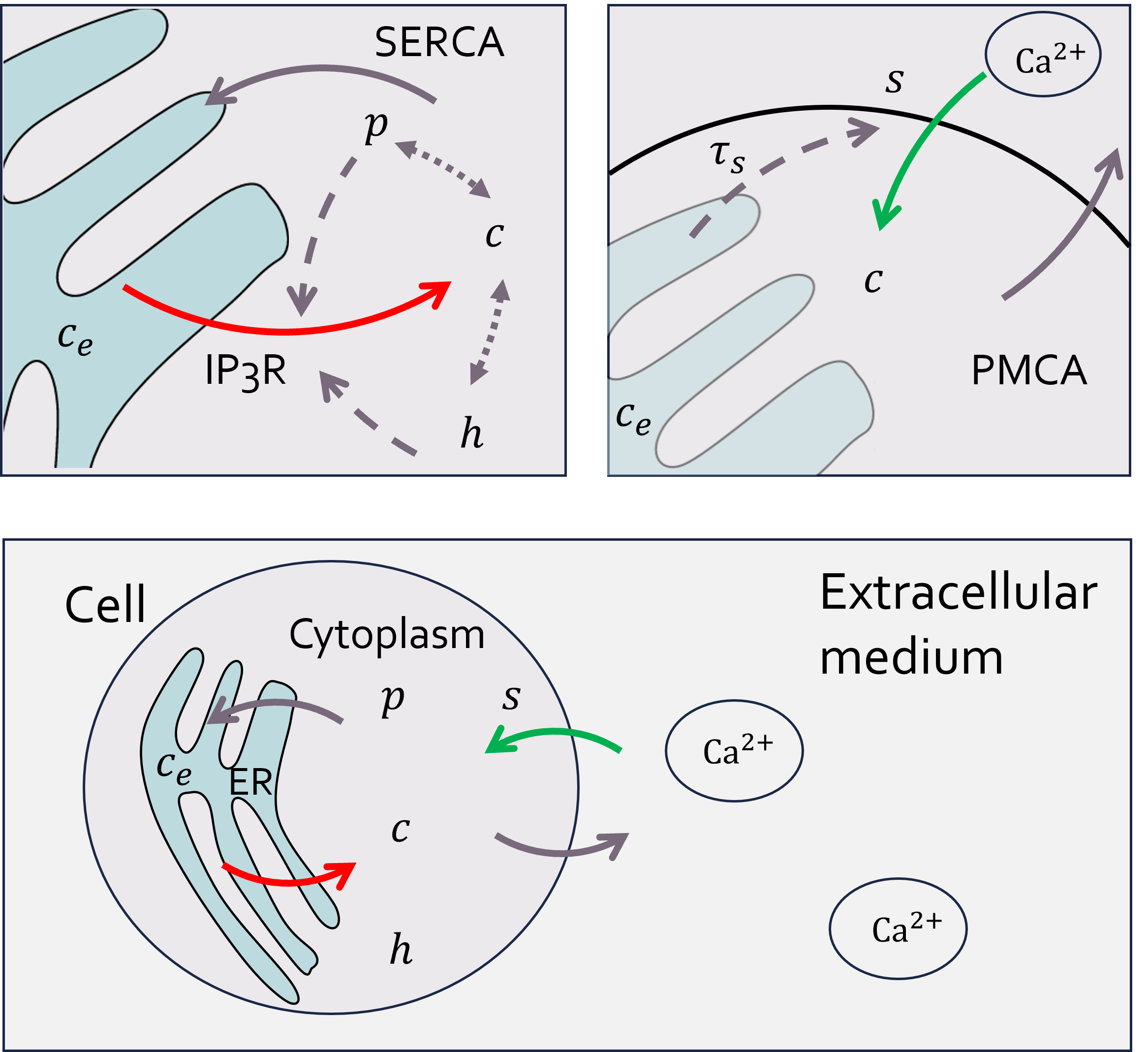
After many long nights of thinking about this phenomenon, we had an idea: what if the cells actually contained two oscillatory mechanisms? The external mechanism (shown in green in the diagram at the top of the page) which was well studied at the time, and an internal mechanism (red) which was overshadowed in ‘normal’ circumstances, but resurfaces once the external mechanism was silenced (e.g. due to lack of an external source)? With this in mind we set off to create a system of ODEs (represented by the same diagram) which could, under the right conditions, replicate these experimental results. The following picture shows some simulations of our model:
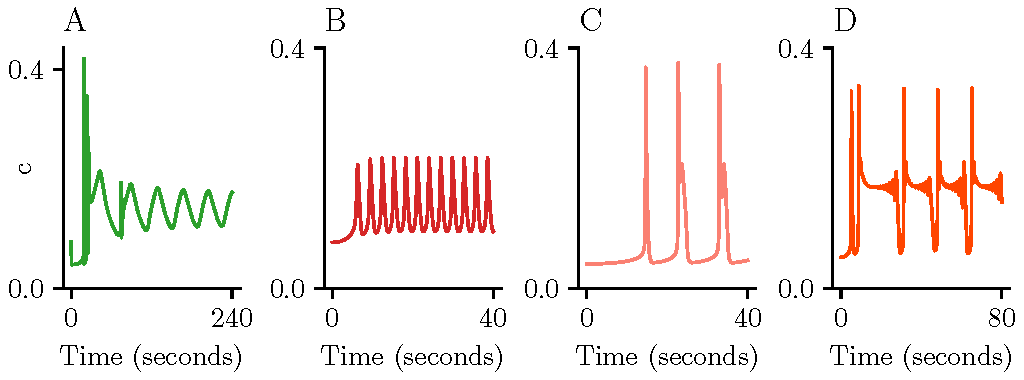
Which look qualitatively similar to the data! This result was a great starting point, but it only explained the cases where the primary mechanisms is either fully switched on or off. What happened in situations where this mechanism was only partially switched off, like in cells without either STIM1 or STIM2? We still needed to figure that out…